Showing posts with label Garden. Show all posts

Tuesday, October 20, 2009

Dog Lawn Burn remedies dangerous?

Two burn spots that I am working on re-growth

If you have a small space for a lawn like I do and like to let your dog out to enjoy it, burns may be an important issue to you. This summer, I began using a popular lawn burn prevention tablet for our dog Daisy to eat so that her urine PH would be neutralized in hopes to keep our lawn from being damaged. However now I am concerned that this may have contributed to (or even caused) her having a bladder infection.

After searching the internet for information on possible dangers of these lawn burn remedies and finding very little information or experiences, I wanted to share our story today on my blog. I hope that it may be useful information for others.

CAUTION: the below may be too wordy for some of you who are not interested in this matter directly ('Mom'♡).

We have a Dichondra lawn, which is pretty hardy, however, our soil does not drain well. I hate to call it soil even since it is composed of mainly clay it seems (this area used to be marshy tidelands from what I understand). Of course I prepared the area that was to be 'our lawn' with bags and bags of appropriate lawn soil (this took about 6 months), otherwise, I doubt any grass or other lawn type ground cover would have taken root. Our Dichondra lawn is beautiful and green all year round and super easy to maintain. It's especially nice to have that nice lush green to see everyday when living in a metropolis like Tokyo.

Then came our dog, Daisy. During the rapid growing seasons (spring and summer) the lawn can take all the punishment Daisy dishes out, but once things start getting colder and the position of the sun changes, the Dichondra goes into a sort of 'hibernation' mode. Then the dog urine burns a dead spot that doesn't grow over and then ends up being a spot of dirt. I take Daisy on regular walks but she still likes going outside in her garden too (and it's nice when I'm feeling tired or unwell that she can 'go' out in our garden).
A spot where the Dichondra has recently died, next step will be plain dirt during the slow growing seasons of late fall and winter.

The whole reason for putting in our lawn was to cut down on the dirt (which can be muddy during rain) and dust that blows around the patio and eventually enters the house, so obviously I wanted to find a way to remedy the lawn burning.

Last winter I made the lawn inaccessible to Daisy with this green garden net (in the photo here above). Since I had trained her to potty on a tray that holds disposable 'potty' pads/sheets for during times we were traveling and emergencies (like inclement weather), I then set up the potty tray on the lanai (patio). But she doesn't really like going on that and seems to wait to use the tray until it's a last resort (it seems to be more enjoyable to 'go' on grass etc.). There were even a few accidents in the house because she held it so long, she couldn't get out fast enough (sometimes we have to close the doggie door so she doesn't bark excessively at people passing by our fence).

So this summer I tried the lawn burn tablets for dogs. It sounded like a miraculous solution. It did say on the bottle that dogs with certain illnesses such as 'acidosis' should not take it. 6 months have past and it really seemed to help (or maybe it was just due to the growing season). I have kind of tapered off, not being religious about giving them daily. About 3 weeks ago dead spots started appearing again, as the weather is cooling down and full sunlight is not reaching the entire lawn anymore. So I put up the net and Daisy had to start using the potty tray on the patio again.
View of the netting off lawn and the 'potty tray' on the patio.

Because of using the potty tray, I was able to see that Daisy was 'ill' far quicker than I could ever have otherwise. I noticed last night after she urinated, that the color was much different that usual. It was almost red and there were little darker red spots. Also I could see a 'sparkling' in the urine, like it was crystallizing. So off to the vet we went this morning. She was diagnosed with 'cystitis' which is really a catch-all term for infections in the bladder or even urinary tract. She is on anti-biotics and a special diet for 2 weeks.

Now, I am left wondering, could the lawn burn remedy have had a hand in this? I realize that UTI/Cystitis is rather common, especially in a female dog and that Daisy waiting for long periods to eliminate could contribute to infections. But, I have to wonder too, if her PH is off, that is exactly what the lawn burn tablets work on, the PH, would that make the environment in her bladder friendly for an infection?

So my suggestion is, if you give your dog one of the many lawn burn remedies on the market today, it would probably be good to make sure to find ways to get your dog to drink more water than usual as well as being sure they are able to urinate at least 3 times in a about a 12 hour period (maybe more if they are able to get alot of water down). I would also pay very close attention to how they are doing, maybe monitoring the dog's urine occasionally by catching it in a dish and taking a direct look that the color and clarity are normal. If you are really savvy, you might figure out how to do some PH testing on your 'samples' collected.

After speaking with our Vet today and reading up on this condition, it is clear that the sooner a dog is treated for UTI the better.

Just sayin'.......and wondering....

Friday, March 27, 2009

Birds in our Japan Garden - Tokyo

Japanese White Eyed birds are a beautiful color green. They love cherry blossoms but also perform amazing acrobatics in our garden to catch gnats and mosquitoes in flight. They are also quite fond of the blooms of our Rosemary plants and any fruit we put out such as Mikans, Oranges or Apples.

Today I was inspired to share with you some of the many birds we see in our garden in the Tokyo area, especially at this time of the year. At one point today, there were 5 different types of birds in the garden at the same time, all providing a great service of natural bug control for us!

Some of the photos are my own, taken in our garden, but since it's hard to get the birds to pose well for me, I have included some photos from the internet for a closer and prettier look at each type of bird. One person called Ingo Waschkies (click here) I found has fantastic pictures on the internet of some of the common birds seen in Japan (along with a nice gallery of birds from other places besides Japan).

Who would have thought we could enjoy such a parade of birds in our little postage stamp of a garden in Tokyo, right from the sofa! It makes us cherish our little garden even more.
****************

Brown Eared Bulbul (Hiyodori)
This bird loves our little Mikan tree (tangerines). Here is one having an
afternoon snack of fresh Mikan in our garden.

Another more clearer picture of this type of Bulbul, these are very common in Japan.
*********************

Dusky Thrush
(Tsugumi)
This bird was busy for about 3 hours today running around in the flower beds and the Dichondra lawn finding and pulling out of the ground, cut-worms and Japanese Beetle grubs. I was thrilled since these worms and grubs often are the cause of damage in my garden.
Another picture of a Dusky Thrush
********************

White Wagtail
(Hagusekirei)
This bird is very common around where we live since there are some open spaces, especially around the riverside of the Edo-gawa. Daisy thinks they are fun to chase.

*********************

Daurian Redstart
(Jobitaki)
This little bird is awful cute, it flits around the garden and it's tail bounces around after it lands each time. We don't see these everyday but have them visit quite a bit in the late winter.

**********************

Grey Starling
(Mukudori)
This bird is pretty shy about getting to close to humans, but today there were two in the garden busily finding things to eat. I was surprised to see them since they normally don't' come down on the ground in our garden. Usually we see them in large groups up on the telephone wires or hundreds of them in one tree making quite a bit of noise, and they can be rather messy for anyone and anything under a tree in such circumstances!

************************

Japanese White Eye (Mejiro)
Another picture of the sweet little Mejiro. Their song is as sweet as they look.
****************************

Azure Winged Magpie (Onaga)
This is quite a beautiful bird and very big! It is related to crows and jackdaws. One day, one of these swooped down into our garden and plucked a large Cicada (Semi) off the trunk of our tree as we sat there watching. We didn't even realize the Cicada was there! These birds must have the best eyesight! We see them flying in small groups around the area where our condo is and around the Edo-gawa. They are a little shy and you don't often get to see them very closely.
*************************

Eastern or Oriental Turtle Dove (Kiji Bato)
Here is a picture of one of the friendlier doves that visit our garden. They love to sit and sun in the lawn and as in this photo, various other places in the garden. Before we got Daisy, if we left the patio door open, they would sometimes wander right into the house! They are such a beautiful Dove and you can see by the pattern on their wings why they are called Turtle Doves.

***************************

Bull-Headed Shrike (Mozu)
One of these was in the garden last summer and caught a baby lizard. I was not real happy since I do like the lizards that dwell in our garden, but a bird's gotta eat right? I'm sure it's not easy for the birds in the Metropolitan Tokyo area! I hear that despite their gentle appearance, these birds are considered almost a bird of prey and will even catch sparrows and small mammals!
***********************

Great Tit (Shijyukara)
Another cute bird we love to see in the garden. We don't see these in the summertime, but usually there are a pair that come around to our garden every year in the winter and spring. We put out a bird house in hopes they would nest here but so far not yet. They love gnats and also nuts that we put out for them. Their song is a delicate melody.

Thursday, August 7, 2008

BullFrogs and Japanese Toads in the garden

Well today, as Daisy sat on her new little summer cot enjoying the fresh air in her garden, a huge BullFrog (called Ushi Gaeru in Japanese) jumped into the Dichondra lawn directly in front of her. Although this picture was taken before that 'event' this is exactly where it was (where she is looking towards in this photo above). At first I didn't know what it was in the lawn, then when I opened the door and stepped onto the lanai, that thing JUMPED! He lept at least 3 feet (about a meter) in one hop! He hit a potted plant and knocked it over and then hid in some dried leaves alongside the edge of the garden. Well this was quite interesting! I wanted to get a picture of him so I approached and then he took off. That thing can RUN and I also discovered it could climb a small fence! Finally he hid under a shed I have. I could barely get a look at him.

Daisy was so excited to try and chase him. I had to spend time taking her mind off of it with some juicy bones and treats for a while.

Here is a picture of what we saw and about the same size. This photo comes courtesy of a website on how to control Bullfrogs, I was unable to get a photo of 'our' visitor today. It was much too fast!

An American Bullfrog, they are not native to Japan but were introduced in the 1920's, originally to help farmers earn extra income by exporting frog legs. But they are great jumpers and runners, as we discovered today, and as some would escape the farms, they became established in the wild. Now they can be found all over Japan in the countryside as well as city parks, substantial ponds, rivers and larger irrigation ditches, and our humble urban garden!

click here to listen to a Bullfrog's cal
l

UPDATE-Sept 1
We found the Bullfrog today hiding in the darkest wettest corner of the garden. After carefully holding back some leaves of the large plant he was sitting under, I was able to get this picture without upsetting him.

Funny thing is, it must have disturbed our regular Japanese Toads that live in our garden, under the sheds. They are called Azuma Hiki Gaeru in Japanese. Less than 10 minutes later, I saw one of our usual toads walking towards a shed we have on the opposite side of the garden looking dejected, like he just got kicked out of his house. He is lucky that BullFrog didn't eat him! Here is a picture of our regular Japanese Toad in the lawn. He doesn't move as fast as the BullFrog. The toads tend to freeze when you get too close, as if that would make you no longer interested in them. Silly toads, however the 'freeze' technique does make them very photogenic!

Japanese Toad as he is walking thru the Dichondra lawn. They seem to prefer walking like this and jump as a last resort. It looks funny as they walk across the lawn.

Azuma Hiki Gaeru, Japanese Toad acting like he isn't there, in a frozen position.

Hopefully our BullFrog will hang around, though he might have been traumatized by my trying to take his picture. I'm sure he is awesome pest control. He was so big and looked very well fed. I think he may have come from a nearby taro patch that someone is filling in partially to build some houses on. I used to hear the BullFrogs singing from there (at first I thought someone had cows or oxen!) but it's been pretty quiet over there now. I did however think I heard something outside along the dark damp side of our apartment for the last week or so. Guess it wasn't my imagination!
The next night, Daisy found this Japanese Toad in the garden. His markings are a little more pronounced than the one we saw during the day, maybe not the same toad. The poor thing was 'frozen' stiff in terror. Daisy was really not so interested in him after he stopped moving (she is actually quite gentle with things usually). I brought him in the apartment for a photo shoot, then put him back out in a bushy area so Daisy would give him some peace. Here are a couple really good close up photos for those of you that are interested and not squeamish about froggies.


Monday, June 9, 2008

Indoor Electric Composter - Made in Japan

A photo of the composter from Hitachi (Hitachi BGD-V18 Kitchen Magic)

This past week, Ken bought me the neatest new 'toy'. It's a composter. I have wanted a composter for a while, not having much space out in the garden for a pile, I have been looking for a good small barrel that could be turned easily. I was not that enthusiatic though since outdoor compost piles or containers can be pretty icky and attract unwanted 'visitors' (such as cockroaches and rats). That might not be such a big deal if you have a large yard and can place it far from the house. However, probably because most people in Japan have small or no gardens, here in Japan, they have made the ultimate electronic composter that can be used indoors or on your apartment's balcony! Several companies make one, Hitachi, National (Panasonic), etc. We got the Hitachi BGC-V18 model from Amazon Japan (and it arrived at our door less than 24 hours after placing the order!). I used it last night for the first time. I think this is a great machine!

First of all, it is nearly silent! Unbelievably quiet, I can only hear this or that being turned around inside. Last night I'd put some bits of a corn cob in there and I suspect those were responsible for most of the sounds I heard.

Second, it doesn't generate heat around it like I thought it might. The casing of the machine itself gets fairly warm to the touch, mostly on the back of the machine, but that is it.

Thirdly, it composted the things I'd put into it in only 4 hours and without any smell.

All this and it has a very minimal footprint!

Supposedly, it uses only a few pennies in electricity to run a full course (something like around 50 US cents/50 JP yen a month), which is drastically less than it ends up costing (in money and in the affects to the environment) to throw the material to be composed into the garbage/landfill instead. Because of this, our city will give us some money towards the purchase of this machine once we fill out a form they have. They pay for 1/3 of the cost of the machine. Pretty neato huh?

I am looking forward to seeing how my garden responds to the composted material this summer.

UPDATE June 21, 2009:
Well we have been using this composter for a year now. I really love it. There is some noise once in a while such as a squeak or tumbling sound, but hardly noticeable. I think it depends on what matter is being composted. There can be a slight smell when you open the lid to add things, but it is not repulsive. It smells something like burnt coffee in the bottom of the coffee pot (when someone has forgotten to turn off the coffeemaker). Again, it's not a horrible smell but I do try to pop the items into the machine all at once and close the lid quickly because my husband likes to comment that it's stinky. The final composted material works great in my garden and it seems my tomatoes this year are benefiting from it so far! What is really great is you can take out alittle compost at a time (after the machine has run it's approximately 4 hour cycle). You don't need to wait longer than even one day to use some of the compost, on the other hand, if you prefer, you don't have to use any of it for quite a while (in our 2 person household), just keep adding the matter to be composted and let it run a cycle, and on and on. I did empty all the compost out and give the inside a full cleaning about a month ago. I then had to add a new starter bag of compost accelerator. Very simple and easy.
Seems like these type of composters are STILL not available outside Japan. What a shame! I'm sure they would be wildly popular in the USA as well as many other places. Get smart Hitachi, Panasonic...start making these for the overseas market!!!

Here are some pics.

Here is the machine parked in our kitchen, next to the refrigerator.

The control panel on the top is easy for me to use even though it's in Japanese. Ken helped me with some translation which I have written on the protective plastic covering that it came with. I think I can memorize pretty quickly and remove the plastic and notes later on.

View of the inside after I had run the machine once. In 4 hours the corn cob, lemon peels, cuttings from the garden and other kitchen compostible wastes I put in, have turned into what you see here. The paddles turn around so quietly I hardly knew the machine was on.

Another picture from Hitachi showing how, once you open the front panel, you can have the machine expel the finished compost easily into a bucket.

Monday, December 3, 2007

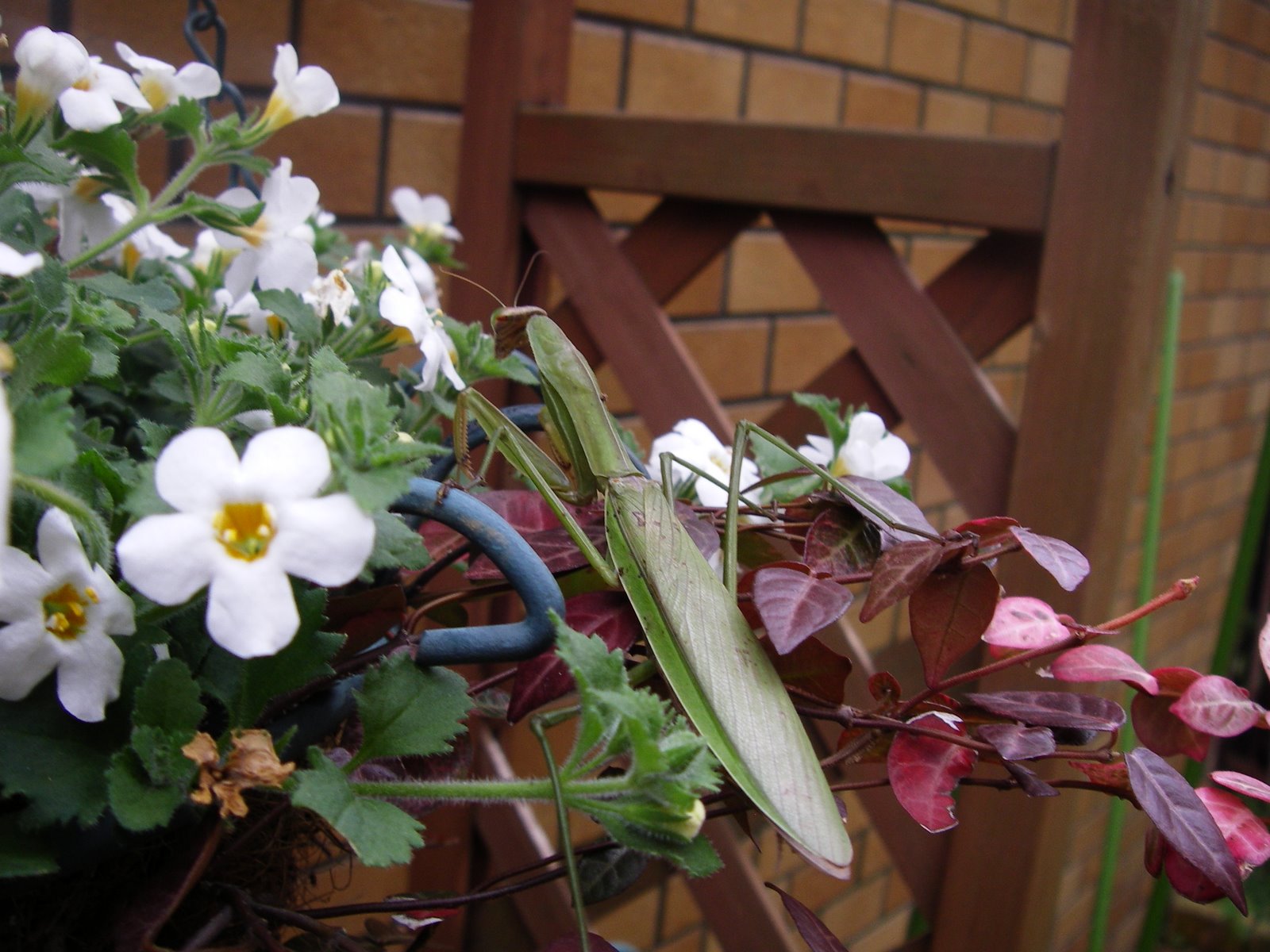
A Japanese Giant Mantis - 大かまきり 

The rescued Mantis on our hanging flower basket

Daisy has discovered in our garden this past week (on November 18th), a Japanese Giant Mantis, which I suppose is the Japanese version of what is called a Praying Mantis in America. She sniffed it out and picked it up in her mouth, perhaps thinking it would make a good thing to play with, since everything is 'funny' to Daisy. I quickly noticed she had something new and of great interest, as she was proudly trotting around the garden like she had just discovered a treasure. Thankfully she was carrying it gingerly in her mouth. So I ran over to her and rescued the poor creature.

We have a little hanging basket of flowers that usually has some little bee or butterfly buzzing around it so I put the Mantis there. All week it has been staying on the basket, moving around I imagine getting something to eat. We have had nice sunny days for about a week now, with temps around mid to high 60's (that's Fahrenheit, which is about 14-16 C). Normally I don't think that we would see a Mantis in the garden this time of year.

I checked one of my favorite blogs that has info on nature in Japan and found that the man who writes that blog also found a Giant Mantis on Nov 25th, although where he is located in Japan it tends to be a bit warmer than where we are (click here natural-japan.net, or see sidebar link, under "My Favorite Web places").

Wonder how long this one will make it into winter. Temps are supposed to 'plunge' from today we heard on the news last night.....We will keep an eye on it (I think it's a 'she').

If looking at 'bugs' close up doesn't bother you, click on the photos to enlarge!

The Mantis a few days after it's rescue, watching some little bees flying around the flowers.

The Mantis today, Dec 3rd. Seems it is trying to stay dry and out of the rain today, hanging on the underside of the basket.

UPDATE: Dec. 5th; The Mantis was found dead today, not surprisingly since it's been very cold at night now. Hopefully we will find some of it's offspring in the garden when the weather warms up in a few months.

Thursday, September 27, 2007

Summer Garden highlights - 我が家の庭のハイライト 

Well, it's nearly done, gone, finished, over...wonderful summertime is ending. I hope we will get warm weather well into November this year, but the garden is already showing signs of the impending cold weather that will arrive in the coming months. I suppose the destructive typhoon (hurricane) we had pass over us a few weeks ago did not help. My cucumber and tomato plants were slaughtered in the relentless wind and were not able to recover. This year I wasn't so into my herb gardening as the puppy kept me pretty occupied. Here is what we had this year:

Edibles:
Rosemary
Lemon Grass
Basil
Lemon Balm
Scented Geranium
Thyme
Chives (mei negi)
Bell Peppers (piman)
Shishito Peppers
Cucumbers
Tomatoes
Echinacea
Lemon (2 regular variety trees and one "giant" variety lemon tree)
Apple Mint
Aloe Vera
Blueberry

Non edibles were:
Plumerias (5 small trees, various colors)
Hibiscus (double flower type)
Jasmine
Angel's Trumpet
Hydrangea
Gardenia
Iilima
Tuberose
Forget-me-Nots
Other various 'always' there plants such as Climbing White Roses, Dichondra lawn, and a few things here and there I don't know the names of.

Only one of the plumeria trees flowered this year, but that was to be expected as they are all only 2 years old (except for one which is 3 years old). It us not usual to get flowers on trees younger than 3 years old. Beginning next year, I hope to get LOTS of flowers!
Plumerias out to the garden in early spring from their wintering safely indoors. They lose all their leaves in the winter but start sprouting new leaves in spring.


A close up of a sprouting inflorescence (a plumeria inflorescence is the clumpy looking growth that will produce flowers). Also can be seen are the new leaves being formed (they look like little brown 'horns').


The growing inflorescence, the little green tips are the flowers forming.

The first flower to open with many more ready to open soon!


Finally we have flowers! They smelled SO GOOD. I enjoyed wearing them in my hair or wrapping like a small boutonniere on a wire to give to friends. Daisy liked them too.


A picture from today, end of summer, before the leaves have started to drop off.

As usual, I can not seem to keep lemons on the tree in Japan. I have tried unsuccessfully for 5 years now to get lemons from my trees (I have 2 trees). They get hundreds of sweet smelling blooms and then the fruit starts forming but shortly after this, everything falls off a few everyday until there is no fruit growing anymore! This year, I added a new lemon tree, a variety that is supposed to produce giant lemons and it did keep ONE precious lemon on it. It's is still green right now and it is pretty big! Hope will we be able to enjoy it soon.

The newly forming fruits on the Giant Lemon tree. As you can see here, all but 2 of the little lemons have fallen out. I wish I knew how to solve this problem. Does anyone out there have any suggestions?


Our ONE precious lemon...it's about the size of a softball at the moment!

We got some great cucumbers this year and made some onolicious salads and tsukemono (Japanese style pickles) from them, but the tomatoes weren't very productive this year. Everything else was green and enjoyable all season. The Dichondra even held up well to the tramplings of the new puppy! I'm so glad we chose that for our lawn instead of grass.

Here are some pics of some other things in of our garden this year.
Hope you enjoy the pictures!

Echinacea sprouting from the ground in early spring.

Echinacea growing taller and taller.

A little bee enjoying an Echinacea flower.

Our Hydrangeas in full bloom (they are growing in an extra large container!).

Close up of the pretty purple Hydrangea flowering, it's called Ajisai in Japanese.

Fabulous Scented Geranium blooming in early summer.